Tuesday, April 16, 2019

Dakar to St. Louis, dejeuner with the family of Iba

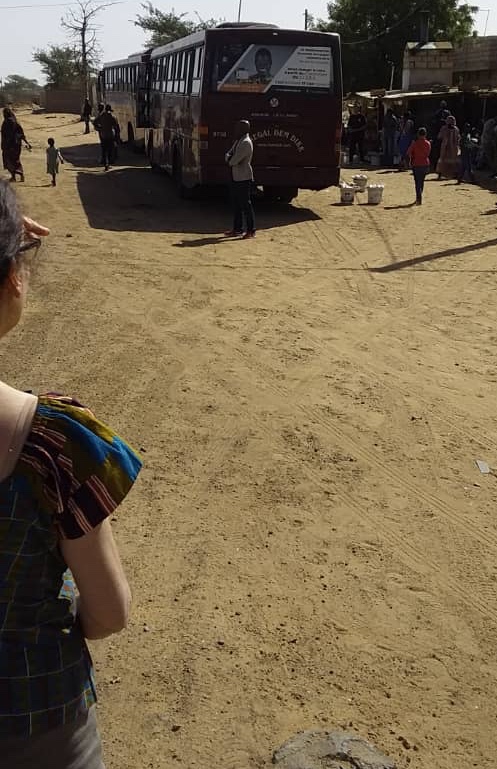
It's a four and a half hour bus ride from Dakar to St. Louis.  One of the pre-departure decisions was what to leave in Dakar.  I didn't want to haul a big suitcase.  So, with required Nalgene water bottle dangling from my backpack, smaller water bottles full off purified water, a few clothes, off I went.  Iba came by in the pre-dawn hours to pick me up en route to the "bus station", a large parking lot filled with a throng of men, women and children.  Buses back up into narrow spaces.  There are no warning beeps but somehow people get out of the way.  It's all very normal.

I dozed off much of the way, occasionally looking out to see expanses of scrub, men and boys on horse-drawn carts, various stages of construction, or decay, in villages.  Ironically, our one stop, Gaeoul, is the village where a friend of my brother, came to instruct Teachers on how best to teach  under the guise of Friends of Gaeoul. This small organization pays families $100/year to keep their daughters in school.

Iba's family is enormously grateful for all the support I have given him to continue in school  (It's another story, a separate blog posting, to explain how I came to know these people).  By bringing one person up economically, this helps the whole family.  Here in Africa, if person A has a little bit of money, he/she must give it to person B, if they have more need.  Basically, everyone is broke all the time.  Children, of which there are many, seem to glide between adjoining families for food, company, care.

Maman Ba prepared a large platter of rice, grilled fish, vegetables (eggplant, onion, carrots, potatoes) for our lunch.  I wish I had a photo of this:  Iba, Maman Ba, Neighbor woman, Malik (Iba's brother), Malik's wife, two other young women in lycee, two boys, one baby.  We are all seated on a large mat around the metal platter, 18" ish wide), some of us eating with a spoon, the older women gathering food into their right hand, squeezing it into a ball and popping it into their mouth.  I found it quite charming how the older women distributed choice morsels of fish or vegetables towards those who they felt needed help getting adequate food (like me).  Between themselves, they speak Wolof,  but I never really feel left out.


Dakar and the Beach, part II

I decided that I needed to be more independent.  Badou had to stay at home while his mother tended to a sick child.  Saliou was not to be found.  I could see the beach from my room.  Whereas one might  think only that (white) tourists would be at risk for theft, the residents here also pay very careful attention to their belongings.  Badou explained to me that he would go barefoot to the beach to play soccer because if he left his shoes on the beach - he learned the hard way that they would disappear.  They don't like when I go off on my own, which was the case when Saliou picked up my message that I had decided to go on my own.  His response was pretty much "Stay where you are - I am coming now!"  Yes, I was approached a couple of times, but for the most part, everyone ignores me.

Saliou  rushed (by Senegalaise standards) to the beach and we watched the beach scene. There were a few white people trying to surf; I had hoped to see some native hotshots  ; )  They were probably all playing soccer or washing sheep! We had some fresh grilled shrimp, which was delicious.

I do want to make a note of what things cost here:
Taxi ride across town (through horrendous traffic):  $4
Dinner for six at my place (grilled fish and chicken, maybe some grilled onions):  $20-25
Custom wrap in the picture below:  $17
T-shirt and pants from the beach vendor: $6  (Noted that I looked for a T-shirt that did not have a logo emblazoned on the back like "Charity run").
Hotel room in Dakar:  $35  (Residence Ba is great!!  It's owned by the famous, rich soccer star, Monsieur Ba)
Hotel room in St. Louis:  $50.


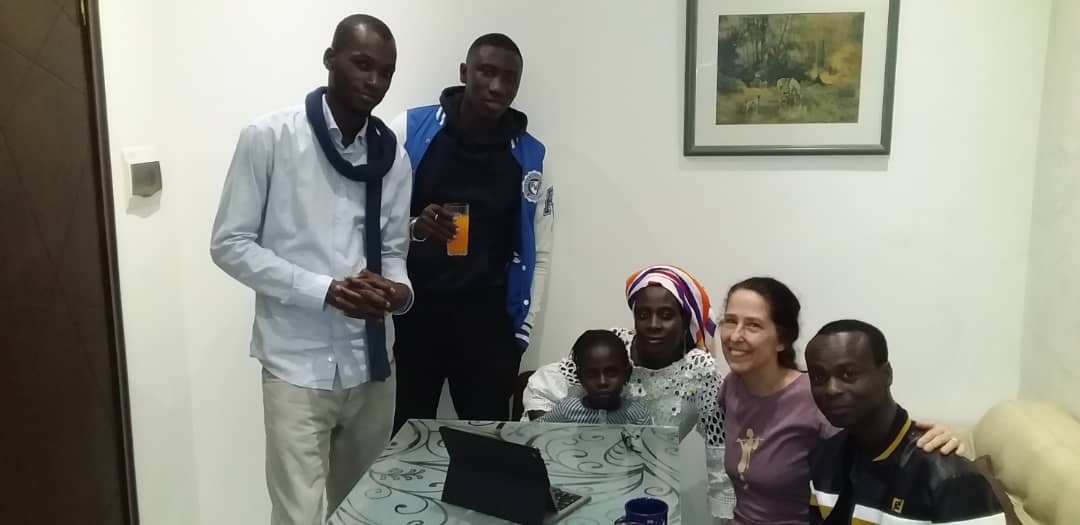
We agreed to get together at 6 p.m. for an early dinner.  I needed to get some good sleep because Iba and I were taking a very early bus to St. Louis.  The "boys", Badou, Iba and Saliou, went to the beach where Saliou and I had eaten earlier to get some grilled fish and shrimp.  Ameth's aunt also wanted to come over. We started eating at 9ish and I finally shooed out the last of "la famille" at 11ish.  We were Iba, Badou, Saliou, Khady, Ousmane and the baby girl.  We called Daniel and all said hello.  ; )
Iba delivered my custom shawl from the sister of Iba's director.  It's very lovely and will go nicely with jeans up to fancy dresses.

We talked alot about Plan International, the organization through which I sponsored Ameth.  Apparently, the quality of their support has dropped significantly.  I'll be interested in finding out more when I go to Mpal.


.

Sunday, April 14, 2019

Dakar to Ile de Goree

Colorful crowded masses, the men in babous and the women in long dresses, their hair covered in matching scarves.  The port was packed, the lines of people standing calmly for the boat.  A scheduled departure of 12:30 slipped back one hour, two hours, finally departing, some of us, at 3 p.m.  Sailing past loading docks and cargo ships,  it was a short trip to Isle de Goree, the island of death, where African slaves were forced onto boats bound for the Americas.  The door of no return was heartbreaking to see, where each slave, shackled and chained, pulling a ball of iron, was loaded onto waiting ships, many destined to die en route.  There were 28 slave houses, one of which was preserved on this UNESCO site.  Tiny stone rooms where slaves were chained to the walls.  Those men under the desirable, best selling weight of 65 kg were force fed beans and palm oil for 3 months.  If they were still underweight, they were sold into domestic slavery, or drowned.  The sick were drowned. Children as young as 7 were sold. Virgins were sold at a premium, the same as the highest price men.  Now, there are ceremonies to remember, and a door of return exists, where the diaspora can return here to remember.  

Many beautiful items were available for sale, with the fabrics being spectacular.  I spent my last penny, however, to buy a small sand painting, a very traditional Senegalese art form.  There will be other opportunities to support these hard working local people. 

The line for the boat to return was equally long; we returned about 8 p.m. and shared a dinner of grilled meat and chicken. What else?  ; )  Saliou and Badou are remarkable people.


Friday, April 12, 2019

Dakar, Day 2

Today was to be the day of visiting Iba's work and shopping with his sisters.  I set my alarm for a rendez-vous with Iba at 10:30.  Getting anywhere in Dakar by car makes traffic in Boulder laughable.  The congestion is breathtaking, or rather, breath removing, as cars belching exhaust inch their way along the main highway.

Iba's boss, Mr. Diop, pronounced "Top" has a small startup distributing motors, bearing and other mechanical parts for industries around the country.  He had lived in the U.S. for several  years but came to Senegal to help grow his country.  Two of his young employees explained to me in darn good English about the business.  In Senegal, no one can be in a rush, and my visit took about two hours.  His business was on the second  floor of the family house.

On the first floor is the boutique of his sister, a spectacularly beautiful woman dressed in vibrant fabrics.  Have I mentioned that the women here are very beautiful, many in colorful traditional dress.
Of course, I had to try on various items of clothing and I purchased a dress, a blouse and a wrap.  She employs six tailors (all young men) and they all work in the back in clean conditions.  Definitely not luxurious, but in this country, to have work is already quite a lot.  Many are on the streets, wandering, selling "you name it".  It's a poor country.  In my mind. recognizing that I could find less expensive clothing elsewhere, I wanted to support not only her but also her six employees. And the clothes are indeed very lovely and well made.

Then, on to the sisters.  Iba and I had talked about eating for at least two hours but after another two hours of animated discussion, a break for the women to pray, donning appropriate full coverage clothing and spreading their prayer rugs, we finally headed out, dodging cars at every step, sand now deep within my shoes, talking and laughing to a "fast-food" restaurant.  I paid for all five of us to shared five plates of chicken, french fries and cooked vegetables (yummy) and three sodas for $20.

I declined a visit to the Statue of the Renaissance or other site seeing.  I was exhausted, recognizing that my trajectories today are NOTHING compared with what Iba, Badou and Saliou endure everyday.

I collapsed upon arrival back at my room and am waiting for Saliou  to come with food.  How is that for a spoiled American?


Dakar

I slept.  Waking up to the bleating of goats beneath my window, laundry flapping in the wind, the sound of the sea. The sounds of lives being lived.  The sun streams in my window, the bed is warm.  The breeze is cool. It's 11 am.

Saliou hails a taxi and starts the bargaining  The offer: 2500 CFA ($4.29) to downtown.  The driver eventually backs down from his offer of 3500 CFA.  I laugh.  It's a long drive.  We stop to visit with his big sister, a seamstress.  If I bring her fabric, she will make me a dress.

Saliou's dad in a crowded office supply store, a room really, packed with copy machines and ink cartridges that Saliou had shipped from China.  No love lost here - not a cent passes from father to son.  Saliou is a self made man, selling ink cartridges, building a client base.

The other accomplishments of the day:  Getting CFA, finding a bank to change to small bills, getting a SIM card, finally eating lunch in a small restaurant, a broiled fish, rice and cooked vegetables.  I'm exhausted, dodging cars and street merchants - the air is thick with particulate pollution.  The same bargaining applies for a taxi.  I explain to Saliou about space junk and the driver asks Saliou in Wolof for a futher explanation.  He understands French, he listens but cannot speak French.

And finally, my sons join me at my room and we eat grilled meats, them standing over the papers of food, no plates, no silverware, we all gorge ourselves.


Their T-shirts from Boulder fit well, the "boys" set up Saliou's computer (gift from Jacques).  We are all very happy.  11 p.m. and I fall into a deep sleep.

Leaving Boulder, onward to Dakar

I felt a weight lift from my shoulders as soon as I walked out the door.  For the next three weeks, no responsibilities at home or work.  Freedom of a sort I had not experienced -  no husband, no garden, no dog.  I was surprised at the feeling. Two girls took this photo of me.  I was to find out later that my T-shirt, any short sleeve shirt, was not warm enough for a rather brisk Dakar.

With the help of a magic small white pill that dear brother gave me, I was able to sleep on the plane, deeply, until Boris, my French seat mate, who migrated to the U.S. nudged me hard enough to wake  me.  I was grateful he swapped seats with me to give me his aisle seat!  no complaints on being woken up!  Boris, born and raised in Paris, now working remote as a software engineer in Grand Junction, Colorado!


Saturday, February 2, 2019

chained to my desk


Chained to my desk out of harm's way,
I'd first weigh each of them and check the swings.
the burliest child would be at my end,
the smallest at the far end
the experiment should start this way.
I would wear my white lab coat, my 
stop watch in my pocket, a lab notebook
on the ground for notes on each trial.
I can only watch out the window and dream,
I am chained to my desk, to keep them from
harm's way.